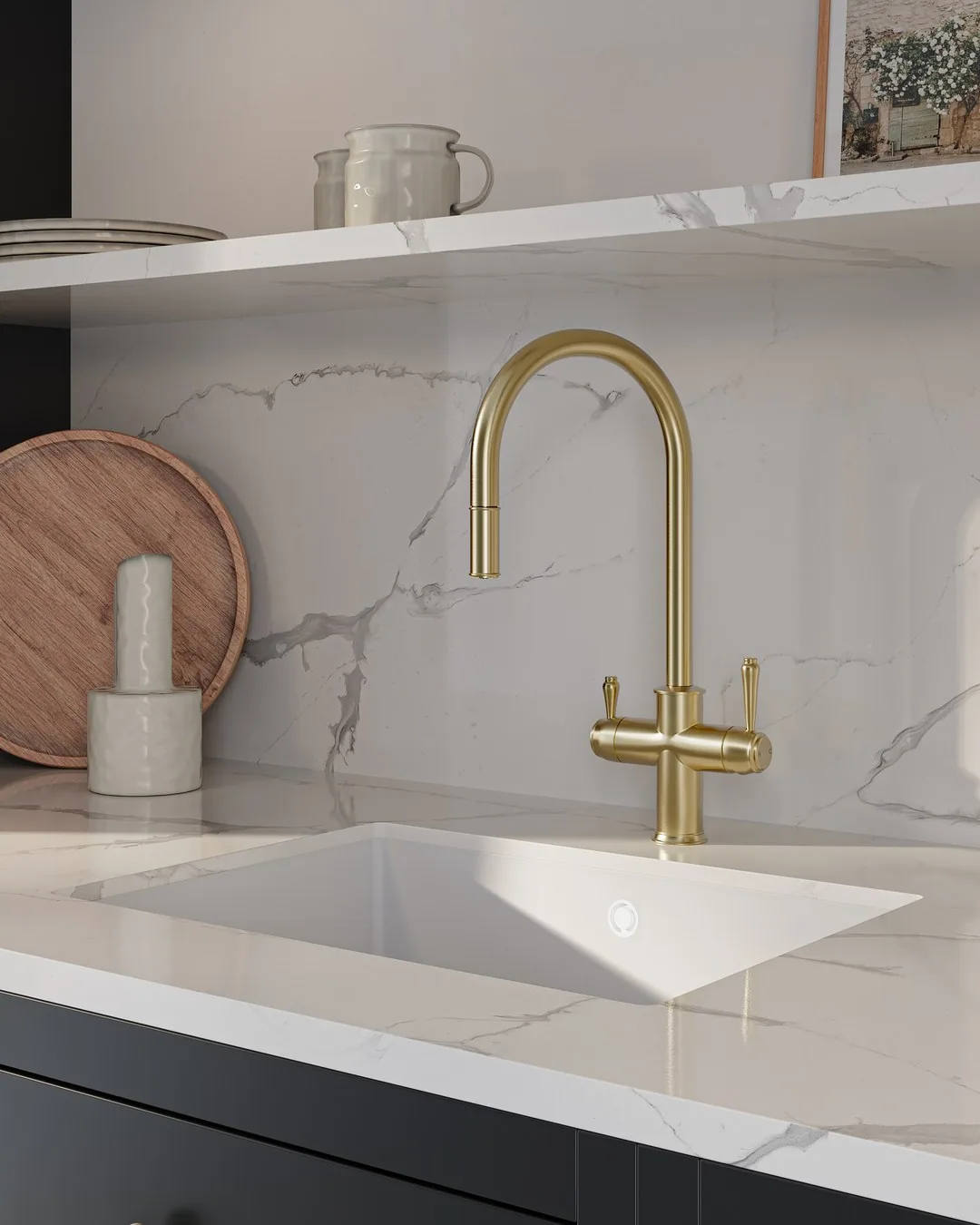
3-way pull-out mixer · brushed brass · in setting
Products by ABI Interiors — CGI by PALACIO 3D
Product CGI · Case Study
A tapware range is not one product photo. It is the mixer, the wall assembly and the spray head — each one needed in every finish, at catalogue quality, before the range goes live.
3-way pull-out mixer · brushed brass · in setting
Products by ABI Interiors — CGI by PALACIO 3D
Give the range the imagery a specifier actually needs: the tap in a real kitchen for the lifestyle pages, and every component isolated and turnable for the product pages — all of it consistent, all of it in every finish the range ships in.
The catalogue is where a tapware range is won or lost. A customer comparing finishes online is comparing images, and any gap in that grid is a decision they cannot make.
Components multiply by finishes. Every part of the family — spout, handles, wall plate, spray head — needs its own frame in every finish, lit identically so the range reads as one product and not as a folder of separate shoots.
The same brushed-metal shader drives all three. Anisotropy follows each part's own geometry, so the brushing reads correctly around a curved spout and across a flat wall plate — the detail that separates a render from a product photo.
One asset set now covers the range: the lifestyle frame for the campaign, the isolated components for the product pages, and the finish loops above for social and PDP use. Adding a finish means updating a material and re-rendering the grid — not booking a photographer, a kitchen and a set of physical samples that may not exist yet.
Products designed and manufactured by ABI Interiors. 3D visualisation, materials, lighting, post and motion by PALACIO 3D. Shown here with permission as part of my professional portfolio.